
This process enables organizations to maintain business continuity while securely transitioning management, preserving apps and data, and minimizing user disruption.
It applies to devices running iOS 26, iPadOS 26, or macOS 26, and is intended for users with Administrator or Device Enrollment Manager roles in ABM.
You can learn more about roles and privileges in Apple Business Manager by following this link.
Overview
Apple Business Manager enables smooth transitions between MDM solutions—ideal for organizations moving from on-premises to cloud management, consolidating devices after a merger, or switching providers.
Key migration features include:
Setting a migration deadline (1–90 days).
Preserving Managed Apps and data on iPhone and iPad.
Managing Activation Lock settings.
Enforcing migration through device restarts when users don’t take action.
Canceling migrations before they start, reverting devices to the original MDM.
Migrating iOS and iPadOS devices without a factory reset.
Requirements
Devices must meet the following conditions to be eligible for migration:
Run iOS 26, iPadOS 26, or macOS 26.
Be organization-owned and enrolled via Automated Device Enrollment (ADE).
- For macOS 26, profile-based enrollment is also supported.
Devices enrolled via Apple Configurator must be past the 30-day provisional period.
If these conditions are not met, the migration deadline option will not appear in ABM, and bulk migration actions will fail, as logged in ABM’s activity log.
Before you begin
Before starting migration, ensure your Applivery environment is properly configured:
The first step is to create your Apple Enterprise account by uploading your Apple Push Certificate to Applivery.
Once in the Applivery Dashboard, navigate to the Apple Setup (1) section under the Settings section and follow this guide for detailed instructions.
Once your Apple Enterprise account is set up, the next step is to configure your Apple Business Manager integration. Start by connecting your DEP and VPP tokens, which will allow Applivery to import your devices and manage app licenses automatically.
You can follow this guide to learn how to connect your DEP token, and this one for configuring VPP licenses.
Once this is completed, you can begin creating DEP profiles and assign them as the default for any device enrolled via ABM.
If applicable, set up Smart enrollment as the default for ABM devices. Finally, ensure that all device policies include the previously installed Managed Apps to prevent any data loss during the migration process.
Sign in to Apple Business Manager as an Administrator or Device Enrollment Manager, navigate to the Devices (2) section, and select the target device (3).
In the top-right corner, click the three horizontal dots (4) and select Assign Device Management (5). Choose Applivery as the destination MDM. Optionally, you can set a migration deadline (1–90 days); if this option is unavailable, the device does not meet the migration requirements.
Once you have verified all settings, click Confirm to proceed.
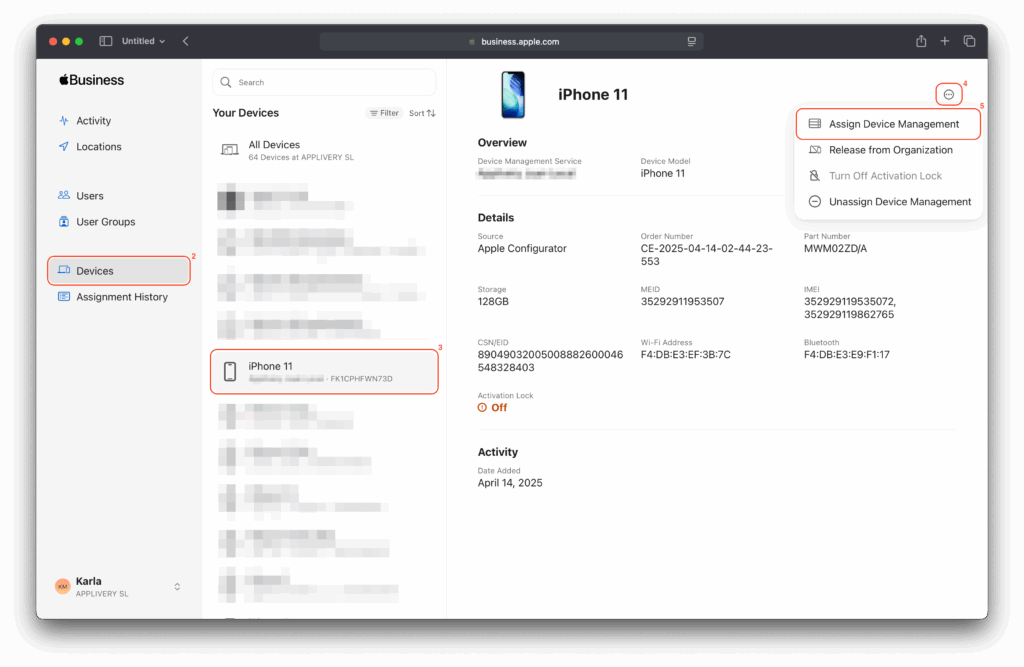
You can also select multiple devices for migration by holding the Command key while clicking and selecting the desired devices.
Back in the Applivery Dashboard, simply click the Sync with ABM button to start the synchronization process and retrieve the latest updates from Apple Business Manager. Any newly added devices will appear in the list below.
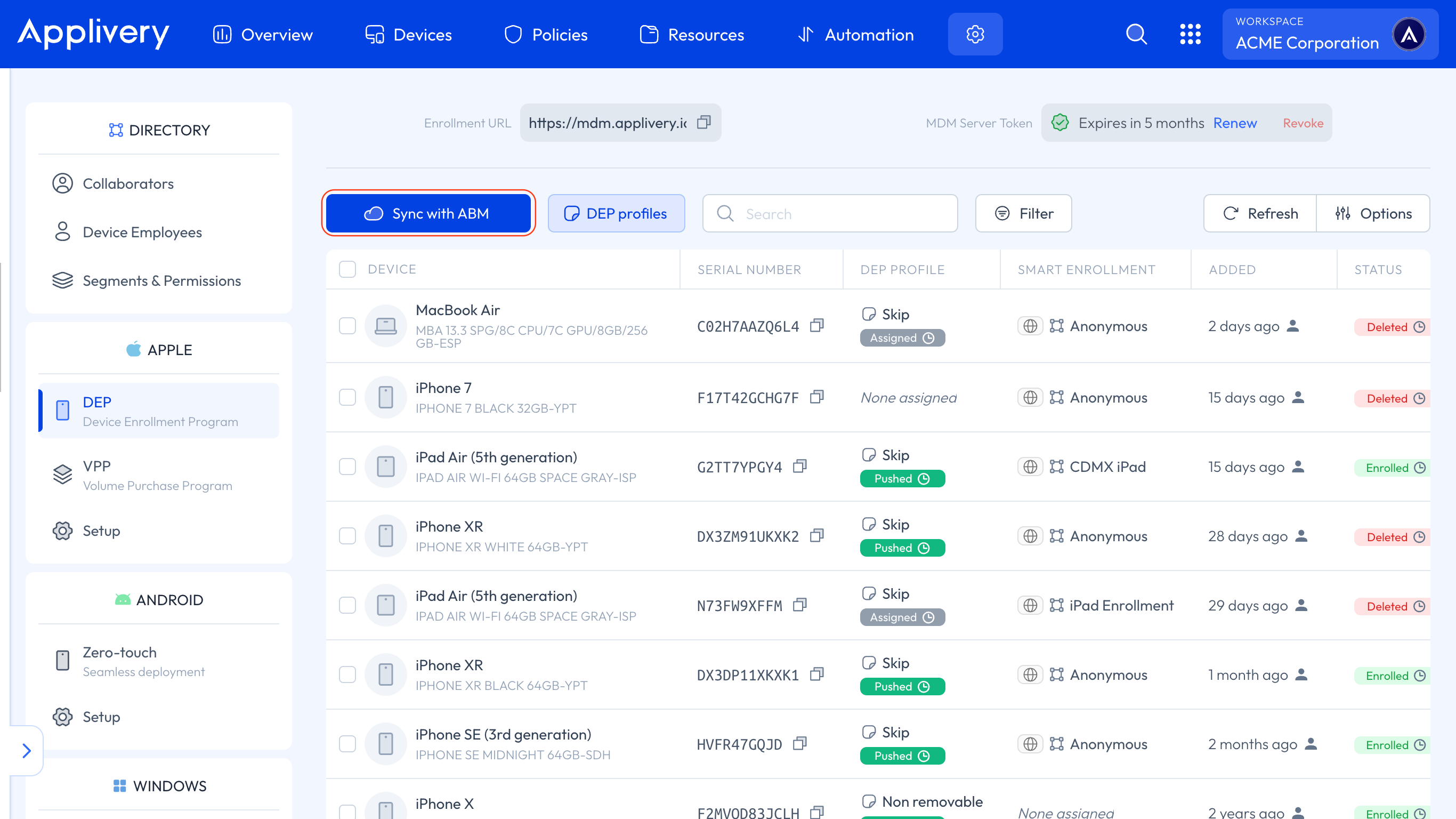
After syncing, devices begin receiving notifications prompting users to start migration. These increase in frequency as the deadline approaches—daily reminders, then hourly alerts during the final 24 hours, and countdown notifications in the last hour. If a device loses connectivity after unenrollment, a Wi-Fi picker will appear to continue setup.
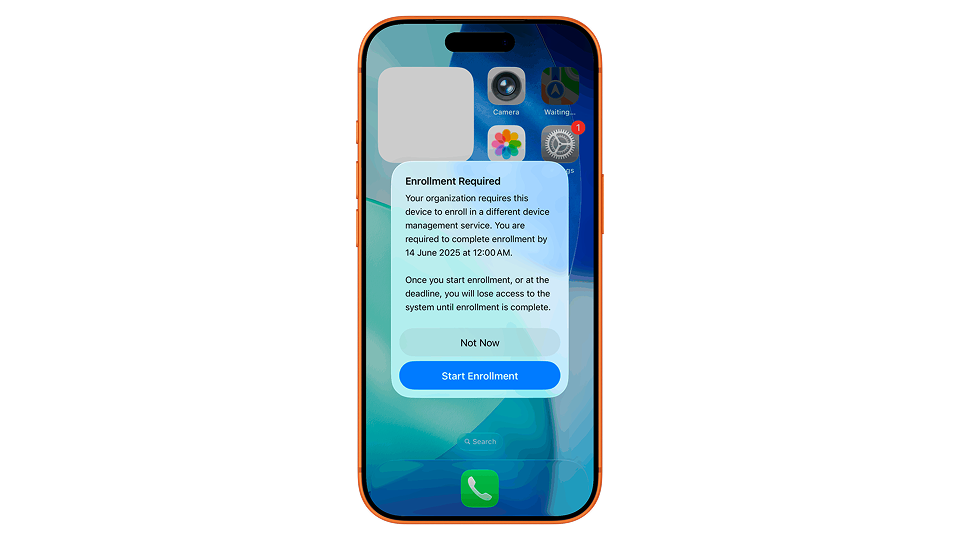
Initial notification
Users receive a notification that migration to Applivery has begun. They can choose Start Enrollment or Not Now (to postpone).
Enrollment
Selecting Start Enrollment redirects users to Settings > VPN & Device Management to initiate Applivery enrollment.
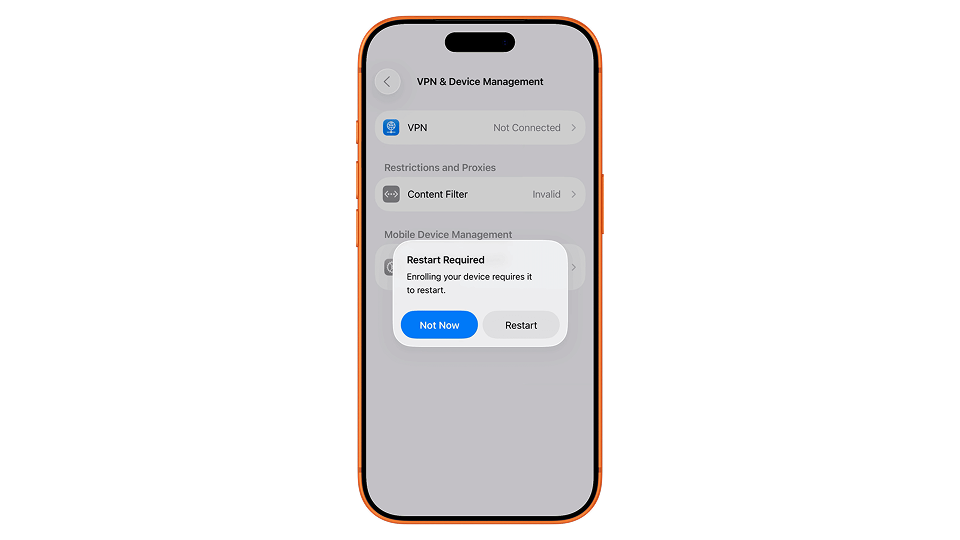
When enrollment starts—or when the migration deadline is reached—the device automatically restarts to apply the new configuration. After the restart, users are prompted to complete the enrollment process. If the deadline has not yet passed, they can choose to delay one final time; otherwise, enrollment is required.
After migration, a device may either complete successfully or fail. In a successful enrollment, the device confirms the migration and reinstalls apps and configurations over the air. In the case of a failed enrollment, the device becomes unmanaged, and you should contact the administrator for assistance.
To modify or cancel a migration for a single device, sign in to Apple Business Manager, navigate to Devices, select the target device, click Change Deadline to modify or remove it, and then click Save.
For multiple devices, select the desired devices in ABM, click Unassign or Reassign, adjust the deadline as needed, and click Save.
Canceling a migration restores the device to its previous MDM configuration and removes migration notifications.
During migration, Applivery manages the device’s Activation Lock status depending on its pre-migration state.
Pre-Migration State | Migration Behavior | Post-Migration Outcome |
|---|---|---|
No Activation Lock | Applivery can enable Activation Lock during migration | Device may have Activation Lock enabled and a new bypass code generated |
Activation Lock from previous MDM | Existing Activation Lock is removed during migration | Applivery applies a new Activation Lock, invalidating previous bypass codes |
Activation Lock handling (general) | Applivery sends an Activation Lock request to ABM before migration completes | A new bypass code is generated and managed through Applivery |
Migration failure | ABM retains the Activation Lock | Device can be unlocked via ABM; previous locks and bypass codes are no longer valid |